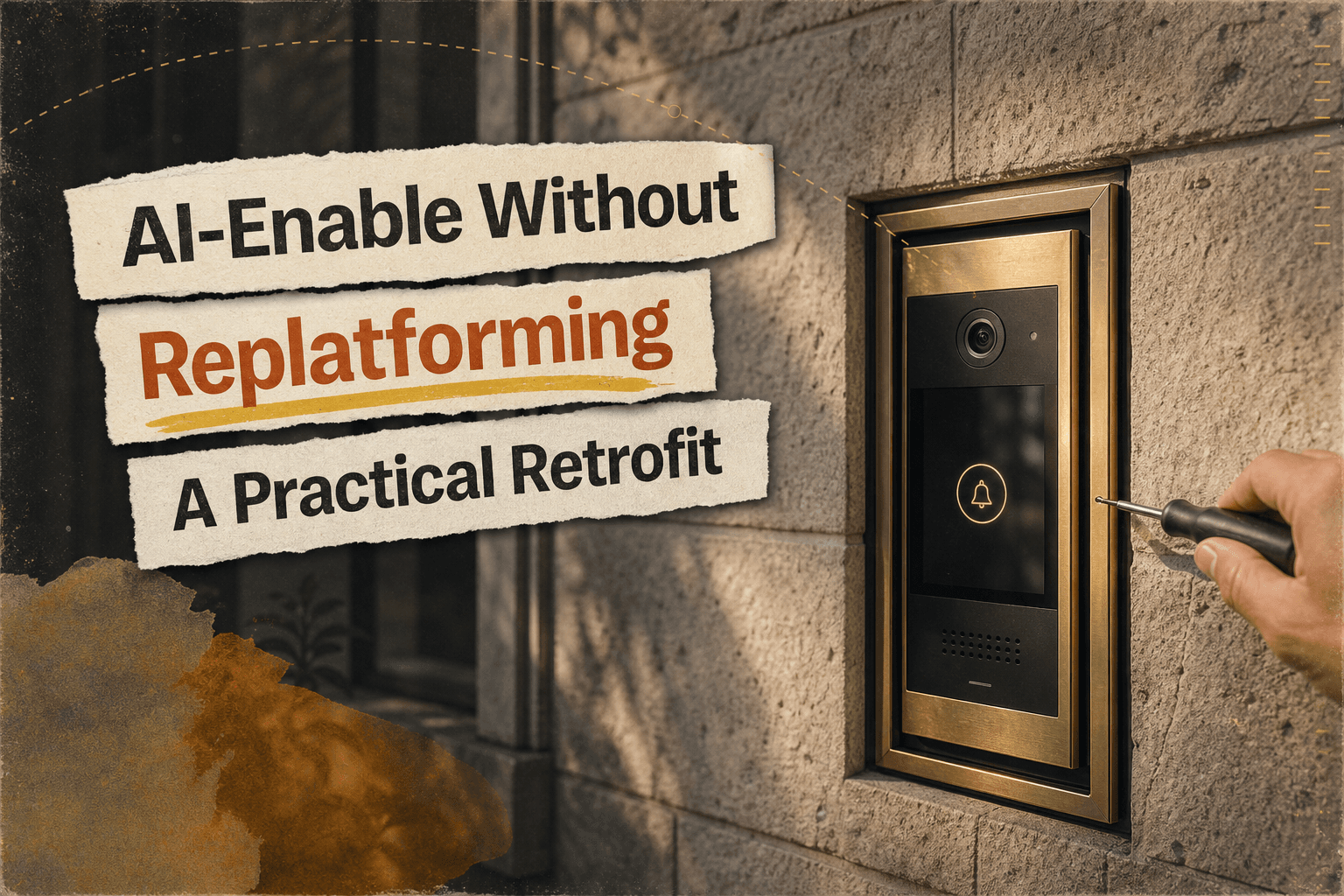
How to AI enable your business without a tech refresh might sound like wishful thinking. AI capabilities are leaping forward every quarter, yet many organisations are running on ageing systems, tight budgets, and teams already stretched thin. The fear is real: if you wait for a perfect stack, your competitors won't. If you rush a full rebuild, you risk disruption, cost overruns, and change fatigue.
Here's the good news: you don't need to rip and replace to realise meaningful value. Think of your business like a well-used building. The wiring isn't perfect and some rooms are dated, but the structure is sound. Instead of demolishing it, you add a smart concierge in the lobby, someone who knows every room, every corridor, and can fetch information or trigger actions on your behalf. In the AI world, that "concierge" is a unified interface layer that sits on top of your existing systems, connecting people to AI safely and efficiently.
This article is a practical, future-ready playbook for decision-makers and technical leaders who want progress without upheaval. We'll explore how a thin integration layer, augmented by large language models (LLMs), can orchestrate tasks across your current tools, from CRM and ERP to knowledge bases and ticketing systems. We'll also introduce Model Context Protocol (MCP), a modern approach for giving AI agents contextual access to data and tools without deep, brittle integrations.
Why this matters now
- AI adoption is accelerating, and the gap between adopters and late movers is widening.
- Legacy constraints are normal, not disqualifying; they simply require a different strategy.
- Doing nothing carries hidden costs: slower response times, higher operating expenses, and lost customer loyalty.
A brief story: a mid-sized distributor wanted faster order support, but its ERP and CRM didn't talk to each other cleanly. Rather than rebuild, the team added an AI-enabled interface that could read customer queries, pull stock levels, reference account terms, and draft replies for human review. No core systems changed. Service improved within weeks, and the team built confidence to extend the approach.
By the end of this playbook, you will know how to identify high-value use cases that fit your current stack, design a unified interface layer that amplifies your tools, apply guardrails for security, risk, and compliance, and evaluate when to build, buy, or partner, and how to start small.
The AI Imperative: Why Standing Still Isn't an Option
The pressure to act now is real because customer expectations, cost realities, and competitive dynamics are all shifting at once. AI isn't a single tool; it's an accelerant for decision-making, content creation, service delivery, and operations. Waiting for a perfect stack sounds safe, but in a fast-moving market it quietly cedes ground.
Think of your business on a moving walkway. If you stand still while others move, you slide backwards relative to them. The walkway is AI progress: models improve, interfaces get simpler, and the bar for "good" service keeps rising. Standing still brings hidden costs, longer response times, manual rework, staff burnout, and customers who try a competitor once and don't return.
Doing nothing invites workarounds, unapproved chatbots, copy-paste between systems, and fragile spreadsheets, that create governance and security risks. Acting doesn't mean overhaul. It means planning a safe, incremental path that proves value quickly and builds confidence.
The Legacy Stack Dilemma: Constraints Without the Budget for Change
By "legacy", we don't just mean old software; we mean any critical system that is hard to change quickly because of risk, cost, or complexity. These platforms often carry "technical debt" (work you postpone that accumulates interest as extra effort later) and "integration sprawl" (a tangle of point-to-point connections that are brittle under change).
The dilemma is simple: your organisation must deliver new AI-powered value, yet large-scale replacement is off the table. You have service-level commitments, frozen change windows, vendor contracts, and teams already stretched. Upgrading the engine while flying the plane isn't feasible.
Common constraints include limited integration surfaces (few or outdated APIs; batch jobs instead of real-time access), data silos with inconsistent formats, compliance and audit overhead, vendor lock-in, skills concentrated in a handful of people, and strict network boundaries that complicate cloud or third-party access.
Think of your stack like a railway network with mixed rolling stock. You can't rebuild the tracks overnight, but you can coordinate timetables, add better signalling, and run more efficient services across what exists. In practice, that means putting a smarter orchestration layer on top, not ripping up the rails.
A Unified Interface Layer: Orchestrating AI Over What You Already Have
A unified interface layer is a thin orchestration layer that lets AI work across your existing systems without deep, risky integrations. Instead of replacing tools, you provide a single, consistent place where people interact with AI, and where AI can safely fetch context and carry out defined tasks.
Think of it like a universal remote. You don't throw away your TV, speakers, and streaming box. You give people one controller that knows how to talk to each device and combine actions into a single, easy step.
A unified interface layer typically connects to systems via approved methods (APIs, webhooks, exports), normalises data into a consistent privacy-aware view, orchestrates multi-step tasks (search, retrieve, summarise, draft, optionally update), enforces guardrails (RBAC, human-in-the-loop approvals, audit trails), offers familiar UX patterns (side panel, chat window, command bar), and captures feedback to improve prompts and next-best actions.
A field services team used five tools to triage issues. By adding a unified interface in their existing ticketing system, AI could pull asset history from one source, warranty terms from another, and draft a response for engineer review. No rip-and-replace. Handle times fell, and satisfaction rose.
Introducing Model Context Protocol (MCP): A Primer for Leaders
Model Context Protocol (MCP) is an open approach that standardises how AI applications connect to external systems. In plain terms, it lets you expose carefully controlled capabilities, like "search knowledge base", "retrieve customer record", or "draft a ticket update", to an AI assistant without hard-wiring bespoke integrations each time.
MCP is a protocol for connecting AI clients (an assistant interface) to one or more servers that expose capabilities from your systems. It defines three things an assistant typically needs: Tools (actions the assistant can perform), Resources (read-only context), and Prompts (reusable templates that guide behaviour).
The leadership value is straightforward: instead of building one-off integrations for each AI use case, you publish a small catalogue of safe, auditable capabilities that any compliant AI client can use. That reduces duplication, simplifies governance, and helps you switch or add models later without redoing the plumbing.
Think of MCP like a jet bridge at an airport. Aircraft models come and go, but the bridge provides a standard, safe way for people to board.
Practical Use Cases: Empowering Teams on Top of Existing Systems
High-impact use cases you can pilot quickly include service triage and replies (classify, pull customer context, surface relevant knowledge, draft responses for agent review), case summarisation (concise, auditable summaries after calls), order and delivery updates (aggregate from ERP, courier portals, inventory), sales assistance (account briefs from CRM and recent interactions), knowledge retrieval ("how do I…?" with citations), HR and onboarding, finance back-office (triage invoices, extract fields, match to POs, flag exceptions), and IT operations (incident summaries, runbook suggestions, stakeholder updates).
To start safely: begin read-only, enable writes behind approvals, use masked or synthetic data in early testing, and measure impact with clear metrics.
Risk, Governance, and Compliance: Doing AI Safely and Responsibly
The goal is simple: unlock value while protecting customers, colleagues, and the organisation. You don't need a vast new bureaucracy; you need a lightweight, well-defined framework that grows with your pilots.
Risks to address include privacy and data protection, security (prompt injection, data leakage, misuse), accuracy and fairness, operational resilience (avoid over-reliance on a single model or vendor), and IP and content rights.
Practical controls from day one: data governance by design (redaction, masking, contextual access), identity and access via existing SSO with role-based controls, guardrails and grounding (cite sources, restrict model behaviour), monitoring and audit (log every tool call), secure architecture (server-side proxy, rate limits, network segmentation), and third-party risk review.
A 90-Day Playbook: AI-Enabling Your Business Without a Tech Refresh
Week 0–1: align, baseline, and safeguard. Pick two or three measurable goals; shortlist simple, high-volume tasks with accessible data; name a product owner and risk partner; inventory data sources, apply masking, draft a DPIA where needed; capture current metrics and success criteria.
Weeks 2–4: prototype the unified interface (read-only). Expose 4–6 read-only actions via an MCP-style server; add a side panel into your existing app; create task templates with citations; build a small test set of real scenarios; route calls via a proxy with logging and rate limits.
Weeks 5–8: expand capability with controlled writes. Add 1–2 write actions behind approvals; run shadow mode comparing AI-assisted output with current process; improve prompts from failure analysis; write runbooks; set daily spend caps.
Weeks 9–12: prove and prepare to scale. Cohort expansion to a second team; A/B measurement reporting on accuracy, containment, cycle time, CSAT, cost; close out DPIA actions; certify reusable patterns; go/no-go decision for scale.
Conclusion
How to AI enable your business without a tech refresh is less about tearing out systems and more about choosing an integration-first path. The thread running through this playbook is simple: add a thin, unified interface that brings AI to the work, not the other way round. Use proven guardrails, start small, and grow what works. You keep the stability of your stack and still move at the pace customers expect.
If you're ready to turn intent into impact, take a single, low-risk step: convene a short workshop with product, operations, IT, security, and legal; pick one high-volume use case with accessible data and clear success metrics; stand up a unified interface in read-only mode; run a weekly "ship room" to review outcomes, refine prompts, and tighten guardrails. After 10–12 weeks, decide how to scale based on measured results.
You don't need a wholesale refresh to move forward. You need a clear goal, a thin layer that respects your estate, and a confident pilot that proves value. Start now, learn quickly, and make AI an everyday ally for your teams and customers.
At Stratagems, we live and breathe Agentic development. We are here to help keep you competitive in this new Agentic age by turning your existing technology investment into an AI powerhouse.